TL;DR: From June 11–24, 2026, OpenAI let Plus and Pro users invite up to three friends to Codex. When an invited friend sent their first Codex message, both people banked one rate-limit reset (a manual quota refresh). Stacked with a free launch reset, users could bank up to four resets, each valid for 30 days. It is a double-sided loop that pays out on activation, not signup.
Every developer who has hit a wall with an AI coding agent knows the feeling. You are deep in a session, the model is finally on the right track, and then the rate limit slams shut. You wait. Maybe you wait hours. That frustration is exactly the nerve OpenAI decided to press when it built the referral program for Codex, its agentic coding tool. Instead of handing out discount codes or account credit, OpenAI rewards referrals with the one thing constrained users want most: the ability to keep working.
It is one of the more quietly clever growth loops we have seen from a big AI lab, and it is worth breaking down piece by piece. Here is how the Codex referral program works, why the design is smart, and what any SaaS or product team can borrow from it. (Anthropic ran a close cousin of this idea with its Claude referral program, which gifts a free week of the product instead of usage.)
First, what a Codex "reset" actually is
A rate-limit reset is a manual, on-demand refresh of your Codex usage quota — instead of waiting for the limit window to roll over automatically, you "bank" a reset and cash it in the moment you are about to run dry.
Codex, like most AI coding tools, runs on usage limits. Depending on your plan you get a certain amount of agent work before you bump into a cap and have to wait for the window to roll over. On June 11, 2026, OpenAI rolled out a feature called rate-limit reset banking to ChatGPT Go, Plus, Pro, and Business users. "Bank" one, save it, and cash it in the moment you are about to run dry.
Screenshot of the Codex "reset available" prompt — a banked reset lets a user refresh their usage limits back to 100% on demand instead of waiting for the window to roll over. Used under fair use.
Every eligible user got their first reset for free at launch. As OpenAI's developer account put it, the first one was "on us." That free reset matters, because it teaches people what the reward is before they are ever asked to refer anyone. You do not have to imagine the value. You have already spent it.
Codex referral program: quick facts
Detail
How it worked
Promo window
June 11–24, 2026 (two weeks, now closed)
Who could refer
Eligible Plus and Pro users
Invite cap
Up to three friends
Reward trigger
The invited friend sends their first Codex message
Reward
Both referrer and friend bank one rate-limit reset (double-sided)
Max resets
Up to four (three referrals + one free launch reset)
Reset validity
30 days from the day it lands, then it expires
Reset banking
Permanent feature for ChatGPT Go, Plus, Pro, and Business users
How the referral loop worked
Alongside banking, OpenAI ran a two-week referral promotion from June 11 to June 24, 2026. The mechanics were refreshingly plain:
Eligible Plus and Pro users could invite up to three friends to Codex.
When an invited friend sent their first Codex message, both people banked one rate-limit reset.
Stacked with the free launch reset, a user could bank up to four resets total during the window.
Each banked reset stays valid for 30 days from the day it lands, then it expires.
OpenAI summed the whole thing up in a single sentence on X: "Invite a friend to Codex and add another reset to the bank. When they send their first Codex message, you'll both bank one to use when you need it."
Screenshot of the Codex referral invite: when your friend joins and sends their first message, you both bank a rate-limit reset that can be redeemed within 30 days. Used under fair use.
A few guardrails came attached, and they tell you the program was designed by people who have watched referral schemes get gamed. A reset is not API credit — you cannot transfer it, sell it, or cash it out. And several tactics were explicitly called out as ineligible:
Self-referrals
Alias-email tricks
Device-linked fake accounts
This is standard referral hygiene, but it is easy to skip and expensive to skip.
Why is Codex's reset-banking referral smart?
Strip away the AI novelty and you find four decisions that any growth team should study.
1. The reward is the product's own scarce resource
OpenAI did not reward referrers with money or swag. It rewarded them with more of the thing they were already rationing. That is a beautiful alignment. The only people who care enough about banked resets to chase them are heavy Codex users, which means the reward self-selects for exactly the advocates you want doing the referring. It also costs OpenAI close to nothing at the margin compared to cash. Contrast this with a generic referral reward like a gift card, which attracts freebie hunters who never touch the product again.
2. The reward triggers on activation, not on signup
This is the part most companies get wrong. The reset only banks after your invited friend sends their first Codex message, not when they create an account. OpenAI is paying for a real activation, not an empty email address. That single choice filters out the low-intent invites that clog up most referral funnels and quietly wreck their ROI. If you only reward genuine product usage, your referrers naturally start inviting people who will actually use the thing.
3. It is double-sided
Both the referrer and the friend bank a reset. Double-sided rewards consistently outperform one-sided ones because the person doing the sharing does not feel like they are begging a favor. They are handing over a gift. "Here, have a free reset" is a much easier message to send than "do me a solid and sign up with my link."
4. Banking creates loss aversion
Calling it a "bank" is not an accident. Once you have resets saved up, they feel like something you own, and losing them (they expire in 30 days) stings. That framing nudges people to earn more and to actually use Codex so the resets do not go to waste. It is the same psychology that keeps airline miles and loyalty points working.
Limitations of the Codex referral program
No teardown is complete without the flaws, and this one has a couple.
The biggest is that the referral window was only two weeks long and has already closed. The banking feature is permanent, but the ability to earn resets through referrals shut off on June 24, 2026. Time-boxing creates urgency, sure, but it also throws away a perfectly good evergreen growth loop. There is no reason a "refer a friend, you both bank a reset" mechanic could not run all year at a slow, steady drip. Where Dropbox rewarded referrals with permanent storage, OpenAI rewarded them with temporary, expiring resets — trading durability for urgency.
The three-invite cap is the other limiter. It keeps costs predictable, but it also caps your most enthusiastic evangelists at three. A tiered structure that unlocked more resets for people who referred more heavy users would have squeezed a lot more out of the same idea.
What SaaS teams can steal from it
You do not need to be OpenAI to run this playbook. The lessons port cleanly:
Reward with your own product's scarce resource when you can. API calls, storage, seats, credits, faster processing. It is cheaper than cash and it attracts the right people. See our roundup of the best referral incentives for more.
Pay out on activation, not signup. Define the moment a referred user gets real value and hang your reward on that event, not on account creation.
Make it double-sided. Give the referrer a gift to hand over, not a chore to nag about.
Build in a little loss aversion. Expiring rewards and visible balances get people moving.
Do not throw away a working loop. If a limited promo performs, there is usually an evergreen version of it worth running on autopilot forever.
Frequently asked questions
How did OpenAI's Codex referral program work?
From June 11 to June 24, 2026, eligible Plus and Pro users could invite up to three friends to Codex. When an invited friend sent their first Codex message, both people banked one rate-limit reset. Combined with a free launch reset, a user could bank up to four resets, each valid for 30 days.
What is a rate-limit reset in Codex?
A rate-limit reset is a manual refresh of your Codex usage quota. Instead of waiting for the limit window to roll over automatically, you can "bank" a reset and trigger it on demand the moment you hit your cap, letting you keep working without a forced pause.
Is the Codex referral program still active?
No. The referral promotion ran only two weeks, from June 11 to June 24, 2026, and has closed. The underlying reset-banking feature is permanent for ChatGPT Go, Plus, Pro, and Business users, but you can no longer earn additional resets by referring friends.
What reward did Codex referrals give?
Referrals were rewarded with banked rate-limit resets rather than cash or credit. Each successful referral gave both the referrer and the friend one reset, triggered when the friend sent their first Codex message. Resets cannot be transferred, sold, or cashed out as API credit.
How long does a banked Codex reset last?
Each banked reset stays valid for 30 days from the day it lands, then expires. This deliberate expiry creates loss aversion, nudging users to keep using Codex so their saved resets do not go to waste, similar to how airline miles and loyalty points work.
The final takeaway
OpenAI took its single most-complained-about limitation, the rate limit, and turned it into the currency of a growth loop. That is the whole trick. The friction became the reward, the reward attracted exactly the right advocates, and the payout only fired on real usage. For a two-week experiment, it punched well above its weight.
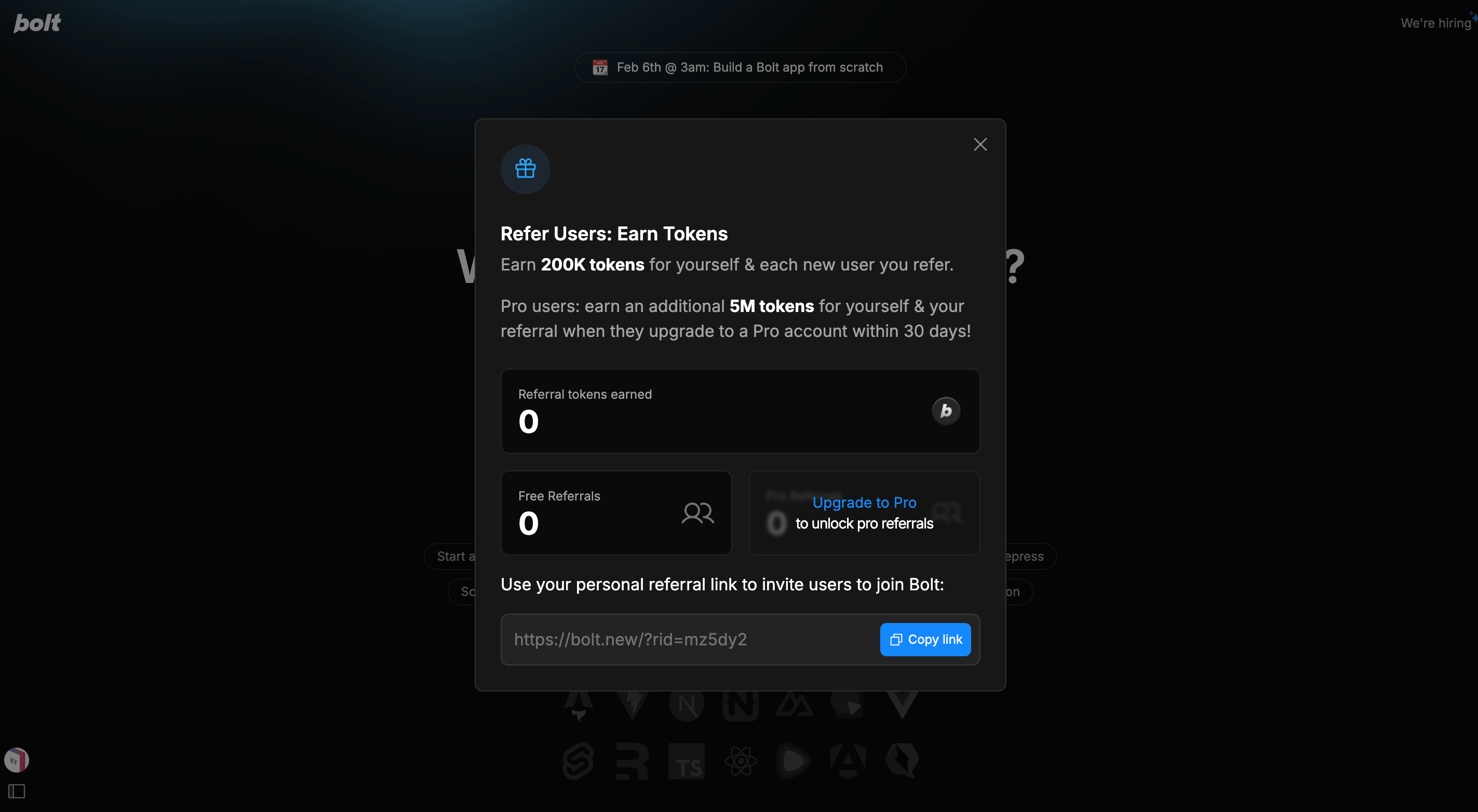
The good news is that this kind of program is not reserved for companies with billions of users. Any business can build a referral loop that rewards activation, works both ways, and runs on autopilot. That is exactly what our referral software, GrowSurf, is built for. You can design double-sided rewards, trigger payouts on real conversion events, and plug it into your product with an API and webhooks, the same way fast-growing AI companies like Bolt.new did.
We have a generous free plan, and you can start a free 14-day trial whenever you are ready to automate your referral marketing.
GrowSurf is modern referral program software that helps product and marketing teams launch an in-product customer referral program in days, not weeks. Start your free trial today.
Build your referral program without building it from scratch
GrowSurf is modern referral program software that helps product and marketing teams launch in-product referral and affiliate programs in days, not weeks.
Anthropic only lets its paying power users hand out Claude invites, and what they give away is a full free week of the product. Here is why that design is so effective.
Once you've launched your referral program, it is not enough to sit back and wait for referrals to come in. Getting the message out to your users is critical to successful referral marketing. Learn how to spread the word with these 10 crucial tips.
SaaS referral programs are one of the most cost-efficient ways for startups to gain new signups and paying customers. Here's 5 reasons why and examples to study
Learn why and how to choose an incentive for your referral program. Discover the best referral program incentives that will turn visitors into customers!



 Salesforce
 Stripe
 HubSpot
 Chargebee
 PayPal
 Wise
Wise Tango Card
 Tremendous
 Recurly
 Braze
Braze Zapier
 Webhooks