 Salesforce
 Stripe
 HubSpot
 Chargebee
 Recurly
 PayPal
 Tango Card
 Webhooks
 Zapier


Growth Marketing: What It Is and How to Use It to Transform Your SaaS Business
Looking for an effective strategy for growing your SaaS business? Learn the top benefits of growth marketing and how to use it to transform your SaaS business.
See what it takes to set up a referral/affiliate program
Explore GrowSurf's powerful referral marketing platform
Watch a video demo of setting up a referral/affiliate program
GrowSurf plugs into your existing tools
GrowSurf vs other referral software providers
Explore our free suite of referral marketing tools.
Explore our free suite of tools built for startups.
Get discounts on top software and services like Notion, Deel, Apollo, and 1Password.
Explore Deals →
Our free loyalty software lets you reward your customers when they leave reviews, share on social media, and mention your brand.
Get It Free →Can you guess which startups made these growth tactics famous? Test your knowledge of innovative marketing strategies that led to explosive growth.
Play Now →Product-led growth (PLG) is a go-to-market strategy that puts the product at the center of the customer journey. Instead of relying on sales teams or marketing campaigns as the primary growth drivers, PLG companies let users experience the product's value directly, often through free trials or freemium models, and allow the product experience to drive conversion and expansion.
In a PLG model, the product does the heavy lifting across the entire customer lifecycle:
Referral programs are a natural extension of product-led growth. When users love a product, they want to share it. A well-designed referral program formalizes and incentivizes this natural sharing behavior, amplifying the organic virality that PLG companies already benefit from. The combination of a great product experience and a structured referral program creates a powerful compounding growth engine.
Successful PLG companies include Slack (team communication), Dropbox (file storage), Zoom (video conferencing), Canva (design), and Notion (productivity). Each of these companies built products that users adopted and spread organically before sales teams were significantly involved. Notably, many of these companies also employed referral programs to accelerate their product-led growth.
GrowSurf amplifies product-led growth by adding a structured referral layer to your product's natural virality. The white-label referral portal integrates seamlessly into your product experience, maintaining the self-serve ethos of PLG. GrowSurf's conversion tracking connects referral activity to product activation and usage metrics, showing how referrals enhance your PLG motion. With 60+ integrations including HubSpot and Stripe, referral data flows into your existing product analytics stack. A/B testing lets you optimize referral incentives to align with your freemium or trial model, while automated reward fulfillment keeps the experience frictionless and on-brand.
In product-led growth, the product itself drives acquisition, activation, and conversion through self-serve experiences like free trials and freemium plans. In sales-led growth, sales teams guide prospects through demos, negotiations, and onboarding. Many companies use a hybrid approach, with PLG for smaller accounts and sales-led motions for enterprise deals.
Yes, PLG companies still invest in marketing, but the focus shifts. Instead of lead generation for sales teams, PLG marketing focuses on driving awareness, organic discovery, content marketing, and referral programs. Marketing in a PLG company is about getting users to the product so the product can sell itself.
Referral programs formalize and amplify the word-of-mouth sharing that PLG companies already benefit from. By providing incentives, tracking tools, and easy sharing mechanics, referral programs turn organic enthusiasm into a measurable, optimizable growth channel that compounds over time.
Trusted by marketing and product teams at fast-growing B2C, fintech, and SaaS companies
Successfully submitted!
Error! Please try again
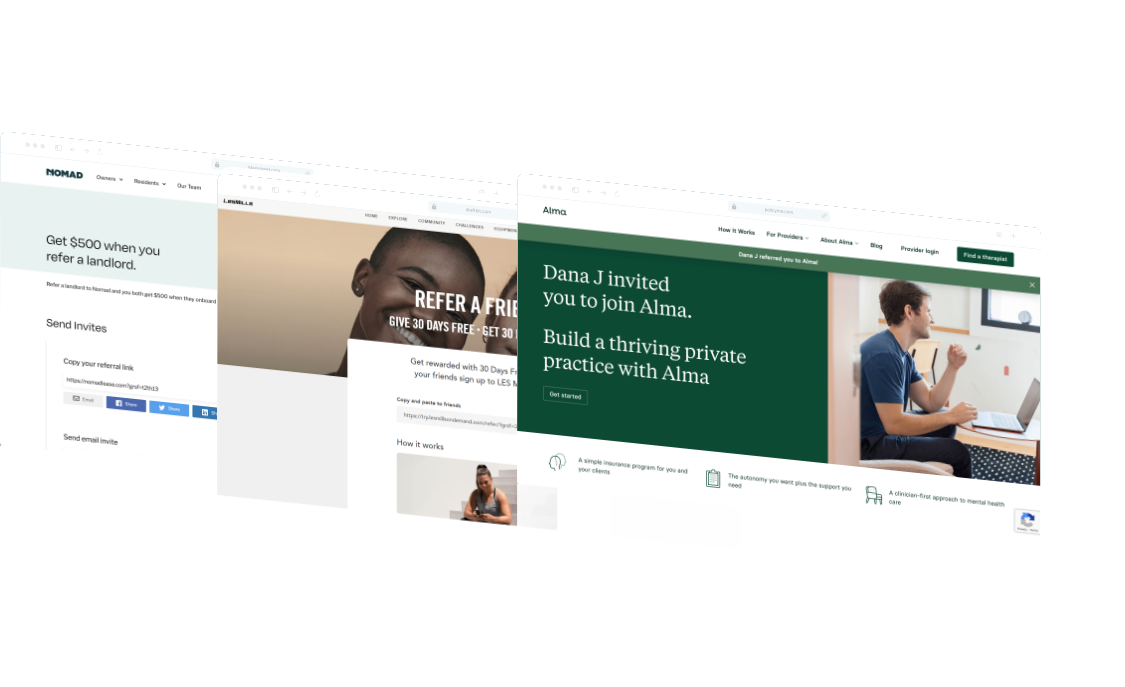
See referral programs that our customers have implemented.